Our mission
Make the Pokemon card market easier to understand by showing where a number came from, what exact card it describes, and how much evidence supports it.
Every price shows the sales it came from, alongside PSA population, news, and what collectors are saying about the cards you follow.
Free to explore. Log in to return to your account.
Track card-grade prices, verified sold comps, population, scarcity, liquidity, and the quality of the underlying evidence.
Scan a focused Pokemon TCG news tape from specialist publishers alongside CardTrends's own market-activity headlines.
Browse every card with recent PSA 9 and PSA 10 sales: sales counts, last sale, 12-month range, PSA population, and the PSA 10 premium.
Build a watchlist or portfolio and publish collector perspectives connected to canonical card-grade pages.
A price is more useful when you can see the evidence, the news, and what other collectors are saying. CardTrends keeps source details alongside each available observation.
| Market Home | Follow market movers, active cards, your watchlist, and the latest Pokemon TCG headlines. |
|---|---|
| Market Evidence | Every card with recent PSA 9 or PSA 10 sales, sortable by activity, PSA 10 premium, population, and price. |
| Community | Read and publish card-linked perspectives without separating the conversation from the underlying data. |
| Portfolio | Connect your holdings to current market values and watchlist activity. |
CardTrends displays available source data and does not appraise or broker cards. PSA population is certified supply, not the number of copies for sale. Pokemon, PSA, and other third-party marks belong to their respective owners; CardTrends is not affiliated with or endorsed by them.
Follow source-labeled prices, coverage activity, and Pokemon TCG headlines in one view.
Every material source-price finding, newest first
Vintage PSA 10s vs PSA 9s: how the same cards have moved in price · WOTC-era sets
Every card printing with at least three recent PSA 9 or PSA 10 sales. The price is the card page's price: the median of its latest five PSA sales in the last year. Sales counts, the last sale and the 12-month range come from the sales we've seen and matched to that card, printing and grade. Our price source lists only a card's latest 30 or so sales per grade, so on busy cards we see just the most recent ones: a count like "31+" means at least that many. PSA population shows only for sets whose census matched PSA's own counts. The PSA 10 premium is the PSA 10 price divided by the PSA 9 price, when both come from sales. How this works
Search mainline Pokemon sets, then open a set to browse individual cards and available Near Mint, PSA 9, and PSA 10 prices.
CardTrends organizes Pokemon card prices, completed-sale evidence, population data, market activity, and collector discussion around one precise identity: card, set, printing, and condition or PSA grade.
Make the Pokemon card market easier to understand by showing where a number came from, what exact card it describes, and how much evidence supports it.
We provide available Near Mint, PSA 9, and PSA 10 prices across approved mainline sets, with deeper sales and population evidence for selected, actively traded cards.
Scheduled data pipelines collect licensed or permitted source data, normalize card identity and price dimensions, validate releases, and publish source-labeled observations.
A card price is more useful beside its source, observation date, completed sales, certified population, and current market activity. CardTrends brings those pieces together instead of treating price lookup, research, news, and collector conversation as separate products.
Identity first. Similar names, printings, variants, and grades remain separate instruments.
Source visible. Prices retain their provider, observation date, support count, and quality state.
Evidence separated. Asking prices, aggregate market summaries, and completed sales are not presented as interchangeable facts.
Coverage is explicit. Missing data stays missing, and deeper research is limited to cards with enough market evidence.
Tell us what is useful, unclear, or missing. Email hello@cardtrends.io.
Across 6,295 Pokémon cards with real sales in both grades, a PSA 9 typically sells for about 22% of the PSA 10 price. The gap depends heavily on the card's era, on how expensive the PSA 10 is, and on how rare PSA 10s are.
Almost every graded card has two prices that matter: the PSA 10 and the PSA 9. The gap between them is one of the most useful things to know about a card, and it varies more than most collectors expect.
We looked at every Pokémon card on CardTrends with at least three real PSA 9 sales and three real PSA 10 sales: 6,295 cards from WOTC through Mega Evolution. For each card, we compared its PSA 9 price (the median of its recent PSA 9 sales) with its PSA 10 price.
The short answer: a typical PSA 9 sells for about 22% of its PSA 10 price. But for the middle 80% of cards, the figure lands anywhere from about 9% to 43%. Three things explain most of that spread.
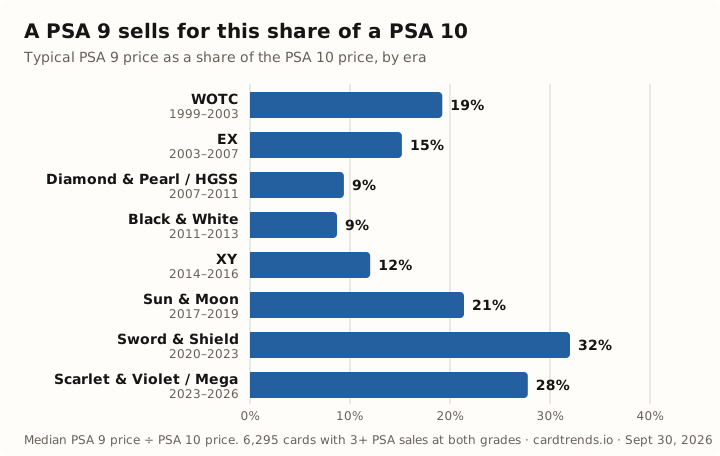
| Era | Years | Cards | PSA 9 as a share of PSA 10 |
|---|---|---|---|
| WOTC | 1999–2003 | 1,691 | 19% |
| EX | 2003–2007 | 744 | 15% |
| Diamond & Pearl / HeartGold SoulSilver | 2007–2011 | 121 | 9% |
| Black & White | 2011–2013 | 81 | 9% |
| XY | 2014–2016 | 301 | 12% |
| Sun & Moon | 2017–2019 | 688 | 21% |
| Sword & Shield | 2020–2023 | 1,043 | 32% |
| Scarlet & Violet / Mega Evolution | 2023–2026 | 1,626 | 28% |
In Diamond & Pearl through Black & White, a PSA 10 typically sells for about ten times the PSA 9. Far fewer of those cards were graded when they were new, and PSA 10s of them are hard to find. For Sword & Shield and Scarlet & Violet cards, a PSA 9 keeps roughly a third of the PSA 10 price. Modern cards are graded in huge numbers, often straight from the pack, so PSA 10s are much easier to come by.
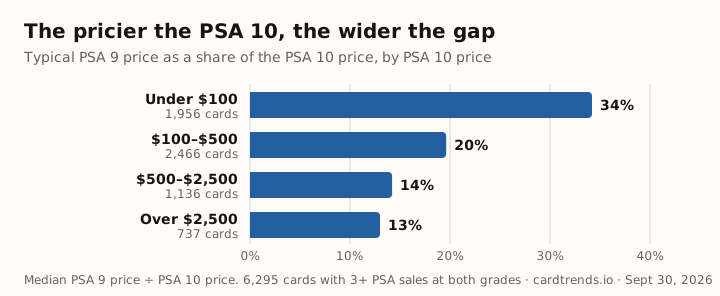
| PSA 10 price | Cards | PSA 9 as a share of PSA 10 |
|---|---|---|
| Under $100 | 1,956 | 34% |
| $100–$500 | 2,466 | 20% |
| $500–$2,500 | 1,136 | 14% |
| Over $2,500 | 737 | 13% |
A $60 PSA 10 usually has a PSA 9 around $20. A $5,000 PSA 10 usually has a PSA 9 closer to $650. On expensive cards, most of the value sits in the top grade.
The PSA population report helps too. We split the 3,270 cards that have a population count at both grades into three equal groups:
That matches intuition: the harder a card is to find in a 10, the more a 10 is worth next to a 9.
Prices below are CardTrends prices on September 30, 2026: each is the median of the card's five most recent PSA sales in that grade.
| Card | PSA 9 | PSA 10 | PSA 9 as a share of PSA 10 |
|---|---|---|---|
| Charizard, Base Set (Unlimited holo) | $3,500 | $30,100 | 12% |
| Charizard ex 199/165, Scarlet & Violet 151 | $355 | $1,375 | 26% |
| Umbreon VMAX alternate art 215/203, Evolving Skies | $2,181 | $3,916 | 56% |
So the averages are a starting point, not a rule. Every card page on CardTrends shows its own PSA 9 and PSA 10 prices side by side, with the sales behind them.
Spot something that looks off for a card you know well? Use Share feedback below. We read every message.